Definition: What is Qi Deficiency? In Traditional Chinese Medicine (TCM), Qi Deficiency (气虚, Qì Xū) refers to a state of lowered vital energy, where the body struggles to perform its essential functions—like digestion, immune defense, and temperature regulation. Think of it as your body’s internal battery running on "Low Power Mode" constantly, even after sleep.
Also Known As: Vital Energy Deficiency, Low Qi, Spleen Qi Deficiency (specific subtype), Hypofunction.
Introduction
You sleep eight hours, yet you wake up exhausted. You catch every cold that goes around. In Western medicine, your blood work might come back "normal," leaving you frustrated. In the framework of a TCM body constitution, this state often points to Qi Deficiency.
While ancient texts describe Qi as the "life force," modern integrative medicine increasingly views it through the lens of bioenergetics. Just as mitochondria produce ATP to power cells, Qi is the functional capacity of your organs. When that capacity drops, your system falters.
Below, we explore the science behind qi deficiency symptoms, how to identify them, and global strategies to reclaim your vitality.
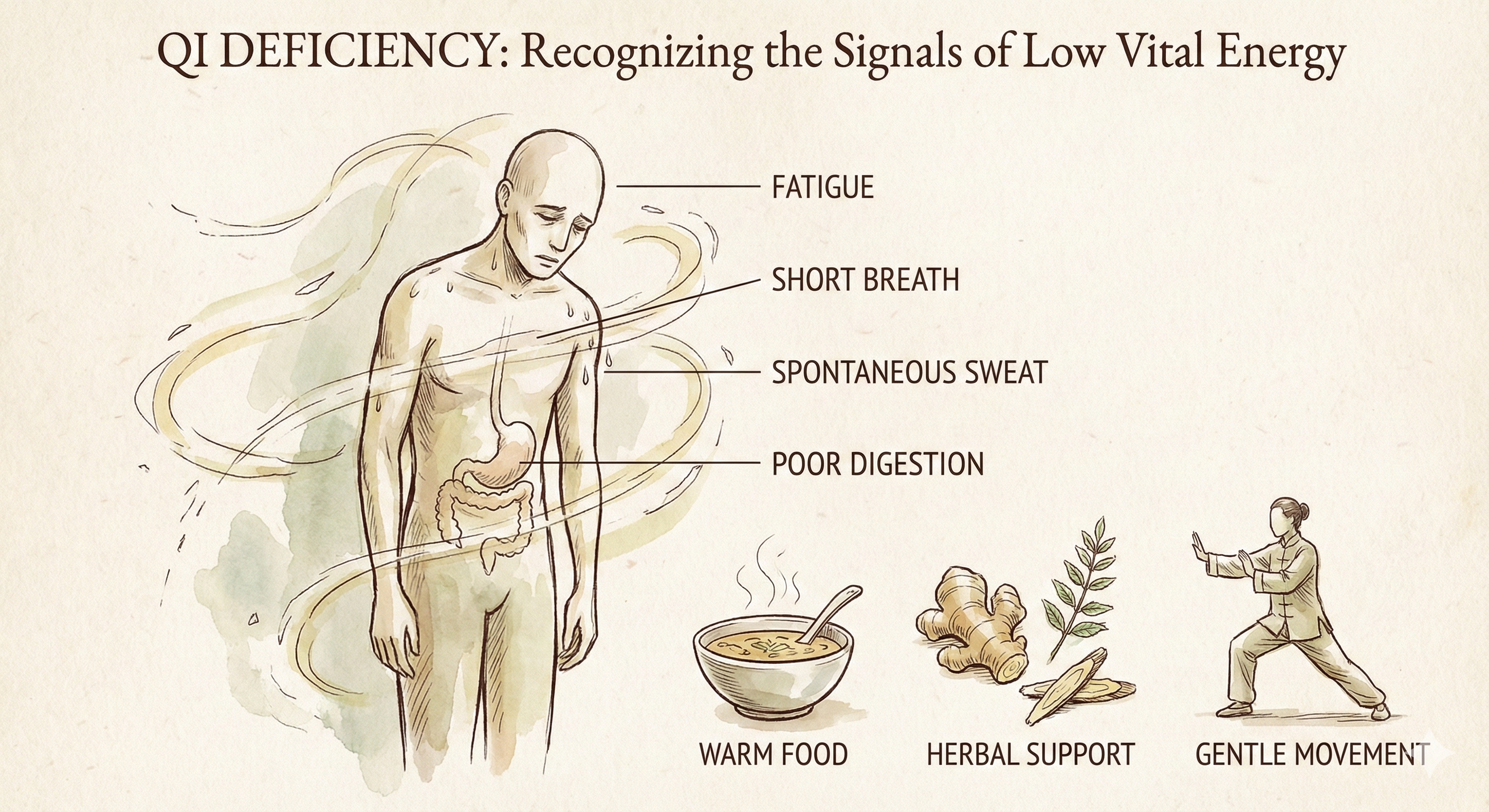
Recognizing the Signals: Top Qi Deficiency Symptoms
Your body speaks a distinct language when it is running low on energy. Unlike "burnout" which is often mental, Qi Deficiency is deeply physical.
The "Tiredness" vs. "Fatigue" Distinction
The hallmark of this constitution is fatigue that worsens with slight exertion. While a healthy person feels energized after a walk, someone with Qi Deficiency may feel depleted.
Scientific Parallel: This mirrors aspects of Chronic Fatigue Syndrome (CFS), where cellular metabolic function is impaired. Research suggests a correlation between Qi deficiency and mitochondrial dysfunction, where the body fails to convert nutrients into usable energy efficiently (PMID: 25625169).
Quick Self-Assessment: The Qi Level Quiz
Rate the following from 1 (Never) to 5 (Always).
1.Do you feel tired immediately after eating?
2. Do you catch colds or flu more than 3 times a year?
3. Is your voice soft, or do you dislike talking because it drains you?
4. Do you experience bloating or loose stools regularly?
5. Do you sweat effortlessly, even when not exercising?
Scoring:
1.5-10: Your Qi is balanced.
2.11-19: Mild deficiency; lifestyle changes can help.
3.20-25: High likelihood of Qi Deficiency. Consult a practitioner.
Key Takeaway: If your fatigue improves with rest but worsens immediately upon activity, and is accompanied by digestive sluggishness, you likely fit the Qi Deficiency profile.
The Science Behind the Slump: Causes of Low Qi
Understanding why your battery is draining is the first step to plugging the leaks.
The Gut-Brain Axis Connection
In TCM, the Spleen is the "source of generated Qi" (digestion). If the Spleen is weak, Qi cannot be produced.
Scientific Parallel: This aligns with modern understanding of the Gut Microbiota. Poor gut diversity affects nutrient absorption and serotonin production. Studies show that herbal formulas used for Spleen Qi deficiency can modulate gut flora, improving systemic energy (PMID: 30263013).
Chronic Stress and "Over-thinking"
TCM posits that "worry knots the Qi." Excessive mental work consumes vast amounts of energy.
Scientific Parallel: Chronic stress keeps the HPA (Hypothalamic-Pituitary-Adrenal) axis in overdrive. This prolonged elevation of cortisol leads to "adrenal fatigue" (a functional term), mimicking the exhaustion profile of Qi deficiency.
Key Takeaway: Qi Deficiency isn't just about what you eat; it's about how your body processes stress and nutrients. Modern research links this state to mitochondrial health and gut flora diversity.
Natural Management Strategies: Diet & Lifestyle
To learn how to boost qi naturally, we must look at inputs (diet) and environment (climate).
The Qi Deficiency Diet: Food as Fuel
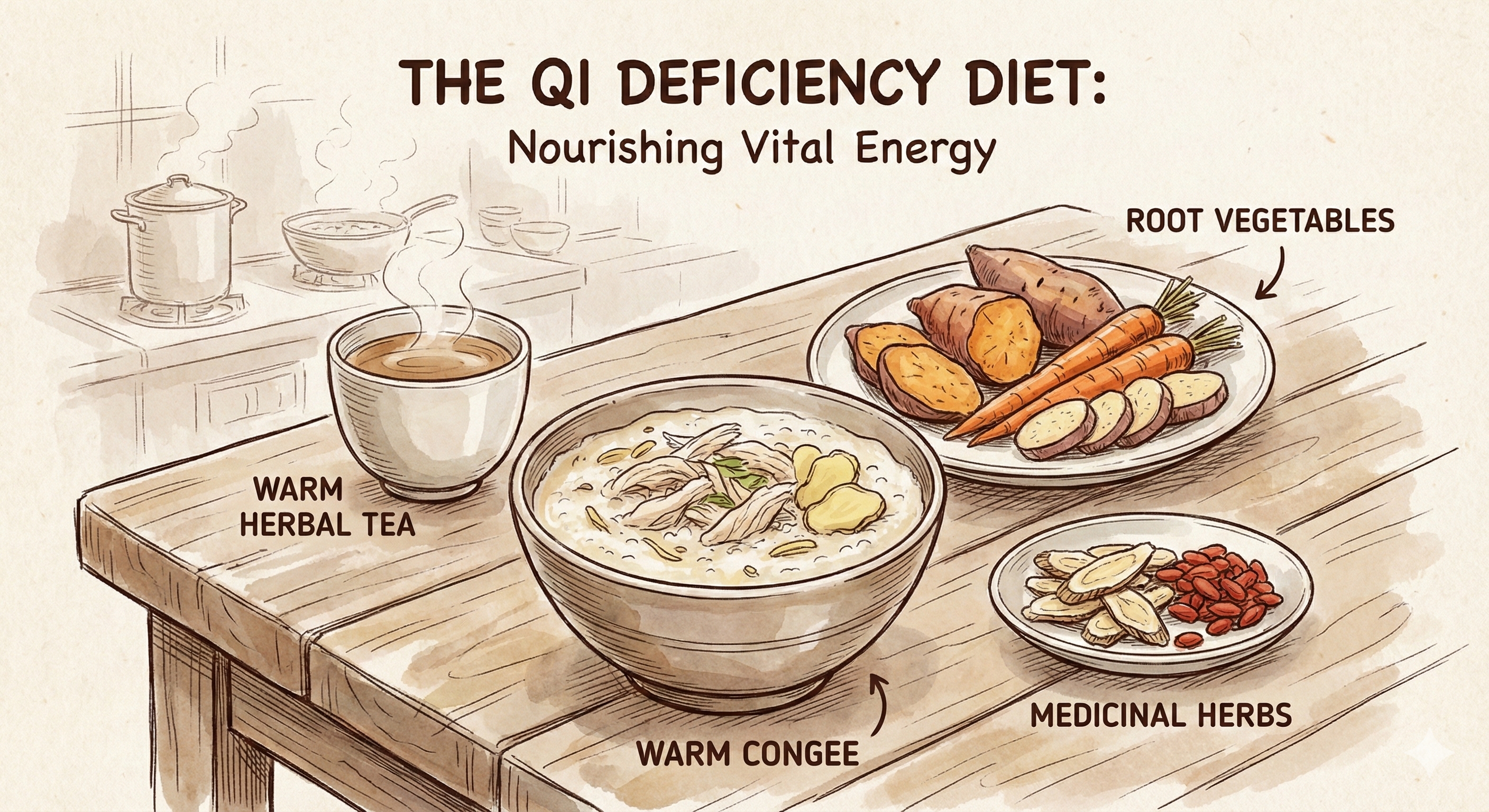
Forget raw salads and smoothies. For a Qi Deficient person, the digestive fire is weak. You need pre-processed (cooked) energy.
Warm & Cooked: Soups, stews, and roasted root vegetables.
Complex Carbs: Oats, quinoa, and rice (easier to digest than wheat).
Adaptogens:
Astragalus (Huang Qi): Known to support immune function. Research indicates Astragalus polysaccharides can enhance immune response and reduce fatigue (PMID: 32660161).
Ginseng: Use cautiously; helps ATP production but can be over-stimulating for some.
Avoid: Cold drinks, raw vegetables, and excessive sugar, which create "Dampness" (sluggish metabolism).
Adjusting for Your Global Location
TCM is not one-size-fits-all; your environment dictates your strategy.
Temperate Zones (e.g., UK, Northern US): Focus on consistency. Regular meal times are crucial to retrain the circadian rhythm of your digestion.
Tropical Zones (e.g., Singapore, Florida): The humidity attacks Qi. You need aromatic foods to "wake up" the spleen. Add cardamom, orange peel, or ginger to your meals to combat environmental dampness.
Cold Zones (e.g., Canada, Scandinavia): You burn more Qi keeping warm. Increase intake of warming proteins like lamb or beef stews and use cinnamon/cloves to stimulate circulation.
Key Takeaway: Focus on warm, easily digestible foods. If you live in a humid climate, add aromatics; in a cold climate, add warming spices.
Frequently Asked Questions (FAQ)
Q: How is Qi Deficiency different from clinical depression? A: While both involve fatigue, depression is primarily a mood disorder characterized by anhedonia (lack of pleasure). Qi Deficiency is primarily physiological—you want to do things, but physically lack the energy. However, long-term Qi deficiency can lead to low mood.
Q: Can exercise help boost Qi? A: Yes, but intensity matters. High-Intensity Interval Training (HIIT) often depletes a Qi Deficient person further. Instead, opt for "cultivation" exercises like Tai Chi, Qigong, or gentle walking. These improve circulation without exhausting your glycogen stores.
Q: How long does it take to restore Qi? A: It is a rebuilding process. With consistent qi deficiency diet changes and sleep hygiene, most people report feeling a "lift" in baseline energy within 4 to 6 weeks.
Conclusion
Identifying qi deficiency symptoms is not a diagnosis of disease, but an invitation to listen to your body. By bridging the gap between ancient wisdom and modern bioenergetics—viewing Qi as your cellular battery—you can take actionable steps to recharge. Start with warm breakfasts, gentle movement, and managing stress.
Ready to dive deeper? Check our comprehensive guide on the 9 TCM Body Constitutions to find your specific match.
Medical Disclaimer
The information provided above is for educational purposes only and is not a substitute for professional medical advice. Consult a healthcare provider before starting any new diet or supplement regimen, especially if you have pre-existing conditions.